Tuesday, August 4, 2026
Offline automated programming: The future of robotic production?

The efficiency of robot programming is a crucial aspect of modern production, especially in small-scale, variable-variance production scenarios. Automated offline programming (AOP) offers new ways to minimize programming effort while simultaneously optimizing production processes. This article will explore how automated AOP works in practice and its advantages for production planning through a concrete example.
Offline programming (PHL): Production-ready robot programs in record time
Offline programming (PHL) transforms your robotic production by digitizing and optimizing the way you generate robot programsPHL allows the development of production-ready programs in a virtual simulation environment.
This not only saves up to 80% of processing time but also has positive effects on overall equipment efficiency (OEE). For example, the PC-based PHL software ensures error-free production processes and the efficient achievement of production targets, even in complex task scenarios.
From offline programming to automated offline programming
Offline programming automation allows for a significant leap forward, as it simplifies and accelerates the programming process. It also enables users without specialized programming skills to generate and edit robot programs, which has a highly beneficial impact on production planning.
To demonstrate how offline programming and automated offline programming work in practice, let's examine two scenarios: First, we'll observe Laurence, an industrial technician, programming a welding process using offline programming software. Then, we'll see how automated offline programming makes her task even easier.
Offline programming in action: A practical example
Laurence, an experienced industrial technician who has also been trained in robot programming, works for a construction equipment manufacturer.
Currently, she is responsible for programming the welding operations for a new excavator. In principle, this means she must follow 5 distinct steps:
1. Specification Laurence meets with the development engineer and the production manager to determine the requirements for the excavator. She receives 3D CAD models that include details on welds, tolerances and clamping points, as well as specifications regarding weld thickness and position, and cycle times.
2. Programming Laurence uses PHL software installed on her PC to import 3D models and plan the robot's movements. The software helps her optimize the robot's sequences and adjust the clamping devices to achieve optimal welding positions.
3. Simulation Next, Laurence uses PHL simulation to validate and optimize the robot's program. She ensures that the robot can reach all welding positions without collision and that the target cycle times are met with minimal air movement. She appreciates the efficiency of the PHL software and the ease with which it allows her to access hard-to-reach component positions—a definite advantage over manually training the robot.
4. Implementation Using a USB drive, Laurence transfers the robot's program to the production cell, uploads it to the robot's control system, and configures the welding parameters. For quality assurance, she relies on a specifications database and her extensive experience. From step 1, all of this has taken Laurence less than four hours.
5. Validation : During the final stage, Laurence validates the program with a test and confirms that the production cell is ready to start producing excavators.
Thanks to digitized robotics programming, Laurence can efficiently generate programs for complex production tasks without leaving their workstation and ensuring that the robotic cell remains productive throughout the operation. With a simplified documentation system, the use of existing CAD data and the reuse of previously programmed solutions allow for rapid achievement of optimal results.
Automated offline scheduling: Taking efficiency to the next level
Thanks to the digitization of robot programming, we now have the means to automate various offline programming functions. Laurence is now discovering how automated offline programming makes her work easier thanks to the new features of FASTSUITE.
Here are the five steps of his new workflow:
1. Digital transfer of specifications The PHL software imports not only all component data from the CAD program, but also all other information relevant to production. In our welding robot example, this includes technical specifications for weld beads and tolerances.
2. Automated programming In PHL's software, Laurence defined quality guarantees and limits for potential deviations from tolerances. Based on this, the software can now autonomously create error-free programs, as FASTSUITE offers an automatic robot trajectory optimization tool that resolves all collision and axis boundary issues while respecting all predefined quality parameters.
3. Direct implementation Laurence now manages the welding process almost exclusively from her PC. She has entered the necessary specifications for the robot's welding tool into FASTSUITE. During programming, the software reconciles the tool specifications with the weld specifications defined by the engineers and automatically transfers the welding process parameters to the robot's programmed trajectory.
4. Faster validation Automated offline programming provides Laurence with everything she needs to virtually test the production process. The robot's movements, including tool orientation, component positioning, signal-controlled actuators, and clamping jigs – everything is present in the simulation.
5. Automated documentation Laurence now extracts the simulation into a neutral format such as 3D PDF or USD. This documentation contains information about which welds were programmed, according to which welding parameters, and in what order. Manually collecting this information is now a thing of the past.
Take advantage of the benefits of offline automated scheduling
The efficiency gains achieved by Laurence's company demonstrate how automated PHL can contribute to improved production processes, and these benefits apply to a wide range of production contexts. The entire process, from design to the final robot program, is digitized, and many tasks are automated along the way.
Here are the main advantages that your company can also benefit from:
⌚SIGNIFICANT TIME SAVINGS - Programming times reduced by 50 to 80% - programs ready for production in hours, not days
🎯 AVAILABILITY OF YOUR FACTORY - Up to 80% reduction in downtime when loading new robot programs
💹 PRODUCTION EFFICIENCY - Shortening of upstream and downstream processes and rapid adaptation to changes
✨ IMPROVED QUALITY OF YOUR PRODUCTS - Improved product quality and reduced remanufacturing costs thanks to greater consistency and precision
🚀 EFFICIENCY OF YOUR RESOURCES - Reduced need for specialized programmers and greater flexibility in staff scheduling
The use of offline programming can reduce system downtime by up to 80% when introducing new programs. By implementing automated offline programming combined with path optimization, companies can further reduce programming time by 50% to 80%, depending on the complexity of the components. Consequently, downtime and programming effort are often reduced from several days to just a few hours.
Arnaud VARLET – Regional Sales Manager – CENIT
Mike encounters the automated PHL
The final stage of our scenario illustrates the importance of resource efficiency and flexible staff deployment. While Laurence is away due to an unforeseen event, the company receives a request for a new variant of the excavator.Mike, a machine operator who has undergone FASTSUITE® training and possesses basic knowledge of robotics, will have to replace her.
Thanks to FASTSUITE®'s intuitive user interface and the quality guidelines and requirements defined by Laurence, Mike can import the CAD model of the new excavator and automatically transfer the programming from the previous variant to the new one..
Mike makes a few minor adjustments to the process parameters and uses the software's optimization features to ensure maximum quality. After successful validation in the actual robotic cell, he can launch production of the new excavator variant.
These two scenarios, drawn from the production environment of a construction equipment manufacturer, illustrate how automated offline programming not only reduces programming effort but also improves workforce flexibility. Companies that adopt this technology early not only improve their efficiency but also lay the foundation for an adaptable and future-proof production process.
To learn more, discover PHL in action
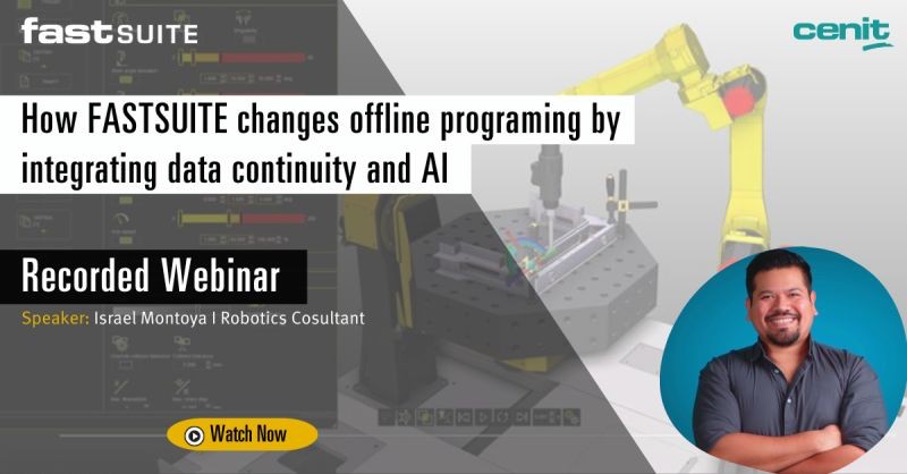
🎬 WEBINAR REPLAY
A unique session to delve into the revolutionary changes (#digital continuity, #AI,...) brought to the automation & programming of manufacturing operations for industrialists.
🎙 PHL AT OUR CLIENTS' HOMES
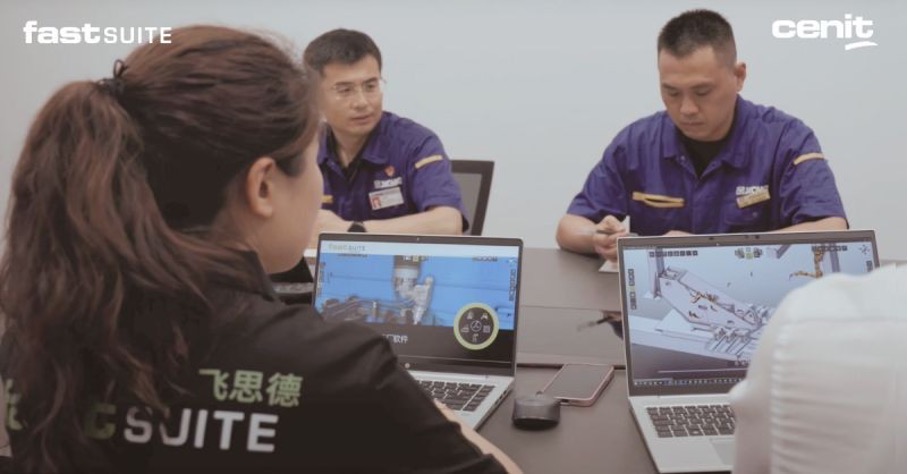
XCMG Group, the world’s 3rd largest construction equipment manufacturer, has revolutionized its productivity and welding quality by using FASTSUITE for offline programming of its robotic welding systems.
💡 Want to learn more about PHL? Need to assess your automation and robotic programming processes? FASTSUITE experts are here to help: